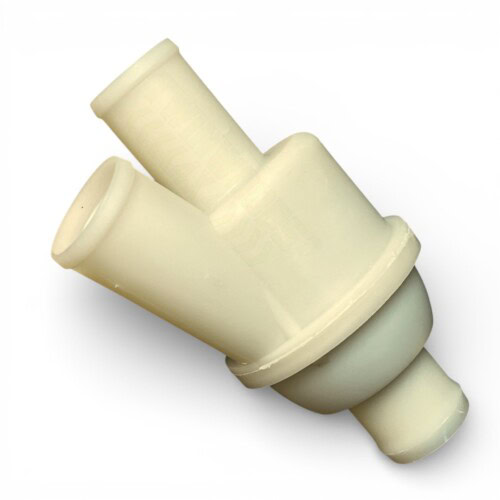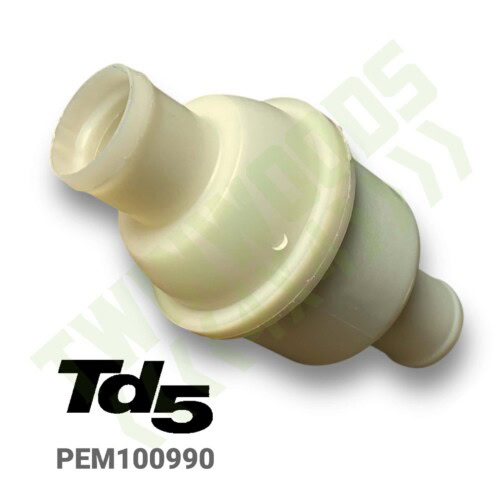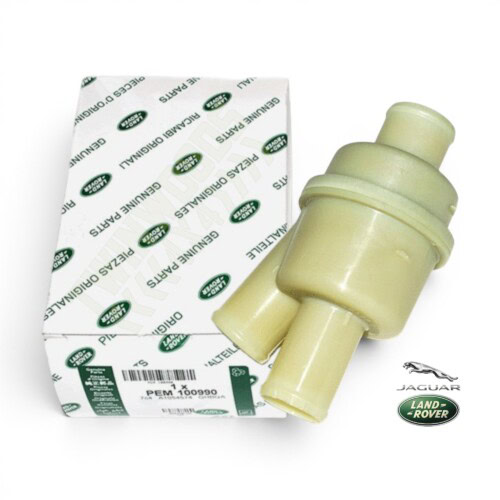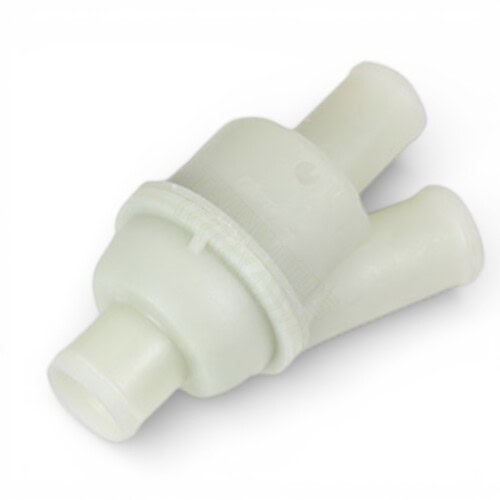

The Land Rover TD5 does not use a conventional single-valve thermostat mounted directly in the engine. Its remote thermostat housing contains two separate mechanisms:
- A wax-element main thermostat, which responds to coolant temperature and controls flow through the radiator.
- A spring-loaded bypass flow valve, which responds primarily to coolant-pump flow and pressure.
Understanding the difference between these two valves is important. The main thermostat is temperature controlled, while the bypass valve is pressure operated. They do not simply open and close together as the engine warms up.
TD5 Cooling System Specifications
| Parameter | Factory Specification |
|---|---|
| Main thermostat initial opening | Approximately 82°C |
| Main thermostat fully open | Approximately 96°C |
| Expansion tank cap relief pressure | Approximately 1.4 bar |
The 82°C figure is the point at which the main thermostat begins to open. It is not a fixed TD5 engine operating temperature. During normal use, coolant temperature can be higher than 82°C while the thermostat progressively regulates radiator flow.
Why the Cooling System Is Pressurised
The expansion tank cap contains a pressure-relief valve which opens at approximately 1.4 bar. This does not mean the system operates constantly at exactly 1.4 bar; it means the cap releases excessive pressure once that threshold is reached.
Pressurising the cooling system raises the boiling point of the coolant mixture. This helps prevent localised boiling around hot areas of the cylinder head and block and increases the margin against coolant-pump cavitation.
A correct coolant mixture, sound expansion tank cap and properly bled system are therefore all important. A new thermostat cannot compensate for low coolant, trapped air, a weak pressure cap or restricted coolant flow elsewhere in the system.
Two Valves with Two Different Jobs
| Component | What Operates It? | Purpose |
|---|---|---|
| Main thermostat valve | Coolant temperature acting on the wax element | Progressively introduces flow through the radiator |
| Bypass flow valve | Coolant-pump flow and pressure acting against a spring | Controls excess flow through the bypass circuit and limits pressure in the heater circuit |
How the TD5 Thermostat Works During Warm-Up
Cold Engine at Low Engine Speed
When the coolant is below approximately 82°C, the main thermostat remains closed and prevents normal flow through the radiator circuit.
At low engine speed, the coolant pump does not produce enough pressure to overcome the light spring holding the bypass flow valve closed. Coolant leaving the engine is therefore directed predominantly through the heater circuit before returning to the coolant pump.
This gives the heater matrix a strong flow of warming coolant and helps both the cabin heater and engine reach operating temperature more quickly.
A small amount of hot coolant can still pass through four sensing holes in the bypass flow valve. This allows the wax element to monitor the temperature of coolant leaving the engine even while the main flow paths are closed.
Cold Engine at Higher Engine Speed
If engine speed rises while the main thermostat is still closed, coolant-pump flow and pressure increase. Once the heater circuit cannot accept all of that flow, pressure overcomes the bypass-valve spring and opens the bypass flow valve.
The valve then modulates according to the available pressure. It maintains useful flow through the heater matrix while allowing excess coolant to circulate through the bypass circuit.
Land Rover’s Defender technical description places this change at approximately 1,500 rpm. The important point is that the bypass valve responds to pump flow and pressure, rather than opening at a particular coolant temperature.
What Happens as the Engine Becomes Hot?
At approximately 82°C, the wax element begins opening the main thermostat. This progressively allows hot coolant from the engine to enter the radiator and cooler radiator-return coolant to be drawn towards the pump.
The cooler radiator return is blended with warmer coolant returning from the heater and bypass circuits before being pumped back through the engine. This avoids treating the system as a simple choice between either complete bypass flow or complete radiator flow.
By approximately 96°C, the main thermostat is fully open and the radiator circuit has its maximum designed flow capacity.
The bypass flow valve is not simply pushed shut by the wax element at 96°C. It remains a separate pressure-operated valve whose position depends on coolant-pump flow, system pressure and the amount of flow that the heater circuit can accept.
How the Thermostat Senses Coolant Temperature
The wax element does not sense only the temperature of coolant leaving the cylinder head.
Approximately 90% of its sensitive area is exposed to hot coolant arriving from the engine through the sensing passages. The remaining 10% is influenced by colder coolant returning from the bottom of the radiator.
This mixed-temperature arrangement allows the thermostat to respond to both engine heat and radiator cooling performance. In cold ambient conditions, the colder radiator return can delay the thermostat response and allow the engine outlet temperature to rise by approximately 10°C more than it otherwise would.
This is a deliberate characteristic of the pressure-relief bypass system, helping the engine retain more heat in cold conditions.
Why Are Some TD5 Thermostats Described as 88°C?
Land Rover’s TD5 technical data specifies that the main thermostat begins opening at approximately 82°C and is fully open at approximately 96°C. Thermostats currently supplied under PEM100990 may also have 82°C physically stamped into the internal metal element.
However, some parts catalogues, product boxes and older listings describe PEM100990 as an 87°C or 88°C thermostat.
The remote housing and mixed 90/10 temperature sensing arrangement explain why the temperature at the cylinder head is not necessarily identical to the number stamped into the wax element. They do not, by themselves, prove why every manufacturer or catalogue has used an 88°C description.
There have also been different pressure-relief thermostat calibrations within the wider Rover and Land Rover parts range, and modern replacement manufacturers sometimes cross-reference or consolidate units which originally had different part numbers.
For that reason, the safest approach is not to assume that every thermostat sold under a familiar part number has identical internal calibration. The manufacturer’s specification and the temperature physically marked on the supplied thermostat are more useful than a generic catalogue heading.
PEM100990 and the Very Late Discovery 2 Thermostat
PEM100990 is the normal thermostat housing for Defender TD5 models, Defender 2.4 and 2.2 TDCI models and the overwhelming majority of Discovery 2 TD5 models.
However, the Land Rover parts catalogue specifies a very late Discovery 2 change:
| Discovery 2 VIN Range | Factory Thermostat Part Number |
|---|---|
| Up to VIN 5A476242 | PEM100990 |
| From VIN 5A476243 | PEL500110 |
This is an exceptionally late Discovery 2 production breakpoint. The same VIN change appears in the factory catalogue for both TD5 and V8 models, so it does not appear to have been caused by a change made specifically to the TD5 engine.
The available catalogue information does not explain the engineering reason for the change. PEL500110 is generally described as an 82°C thermostat with a softer pressure-relief spring, indicating a different hydraulic calibration rather than merely a new number for an otherwise identical housing.
Owners of a very late 5A Discovery 2 should therefore check the complete VIN before ordering rather than relying solely on the vehicle’s registration year.
Common Symptoms of a Faulty TD5 Thermostat
Slow Engine Warm-Up
A main thermostat stuck partly or fully open allows radiator flow too early. The engine may take an unusually long time to warm up and may run cooler than expected during steady driving.
Low or Inconsistent Heater Output
A thermostat stuck open can reduce cabin-heater temperature because the engine struggles to retain heat. Poor heater output can also be caused by low coolant, trapped air, restricted heater-matrix flow or another circulation problem, so it should not be treated as proof of thermostat failure on its own.
Unstable Coolant Temperature
A sticking main valve can cause actual coolant temperature to rise and fall more than expected. Live coolant-temperature data from a suitable diagnostic tool is more informative than relying entirely on the dashboard gauge.
Temperature instability can also result from an air lock, coolant-level problem, electrical fault or failing temperature sensor.
Overheating Under Load
A thermostat which fails to open fully can restrict radiator flow during high-speed driving, towing or prolonged climbing. However, radiator restriction, viscous-fan problems, coolant-pump faults, trapped air and combustion gases entering the cooling system can cause similar symptoms.
Checking a Suspected Thermostat
Monitoring live coolant-temperature data from a cold start can help identify an engine which warms too slowly or behaves inconsistently.
A conventional hot-water test may show whether the wax-operated main valve begins to open, but it does not fully test the pressure-operated bypass valve. The bypass spring and valve need coolant flow and differential pressure to operate as they do in the vehicle.
When replacing the thermostat, the cooling system must be refilled with the correct coolant mixture and bled properly. Trapped air can produce misleading temperature behaviour and may cause overheating even when the new thermostat is operating correctly.
Choosing a Replacement TD5 Thermostat
The temperature calibration and bypass-spring characteristics are both important. A thermostat can physically fit the hoses while still having different internal operating characteristics.
For that reason, we offer known-brand EAC, MotoRad and Genuine Land Rover PEM100990 thermostat options rather than unidentified low-cost housings. Check the vehicle and VIN carefully, particularly on the very last Discovery 2 models.